
Quantum Chemistry Secondary 5: A Comprehensive Study Plan
Quantum-Chimie 5 resources, including interactive exercises and revision materials, are available, with the “Quantum” series offering a flexible approach to the curriculum․
This course introduces Secondary 5 students to the fundamental principles of quantum chemistry, building upon prior knowledge of chemical concepts․ The “Quantum” series, specifically Quantum-Chimie 5, serves as a core resource, providing a concrete and adaptable pathway through the curriculum․ Students will explore atomic and molecular structures, chemical formulas, and the nature of chemical bonding – both ionic and covalent․
Supplementary materials, like workbooks including exam preparation, enhance learning․ Access to the “Quantum” textbook, available for long-term loan from school libraries, is crucial․ The course also touches upon forces, their characteristics (gravitational, frictional), and equilibrium, preparing students for advanced topics like chemical reactions and, eventually, topological quantum chemistry as explored in Bradlyn et al․’s 2017 research․
Atoms and Molecules: The Building Blocks
This section delves into the foundational components of matter: atoms and molecules․ Utilizing resources from the Quantum series, particularly Quantum-Chimie 5, students will investigate how atoms combine to form molecules․ The curriculum covers fundamental concepts like atomic representations and the construction of chemical formulas․
A key focus is understanding the formation of ions and their role in chemical compounds․ The accompanying “Puissance 5 SN ─ Cahier de lélève” provides interactive exercises to reinforce these concepts․ Students will learn to represent these building blocks visually and symbolically, preparing them for understanding more complex chemical systems and reactions explored later in the course, building a strong base for advanced topics․
Representations of Atoms
Understanding atomic structure requires various representational methods, explored within the Quantum series and specifically Quantum-Chimie 5․ Students will learn to visualize atoms using models and diagrams, moving beyond simple depictions to grasp electron configurations and nuclear composition․ The “Cahier de lélève” offers practice in interpreting these representations․
This section emphasizes translating symbolic representations – like atomic numbers and mass numbers – into visual models and vice versa․ Mastering these skills is crucial for predicting atomic behavior and understanding chemical bonding․ Resources like interactive activities, mentioned alongside “Puissance 5 SN”, aid in solidifying comprehension, preparing students for more complex molecular representations and chemical formula construction․
Chemical Formulas and Ions
This segment of Quantum-Chimie 5 focuses on translating chemical names into accurate formulas and understanding ion formation․ Students will learn to identify common ions – both monatomic and polyatomic – and apply the rules of valency to construct correct chemical formulas․ The accompanying “Cahier de lélève” provides ample practice exercises, reinforcing these concepts․
The curriculum covers predicting the charges of ions based on their position in the periodic table, and understanding how ions combine to form neutral compounds․ Interactive activities, as highlighted in resource descriptions, will help students visualize these processes․ Mastery of chemical formulas and ions is foundational for understanding chemical reactions and stoichiometry, preparing them for advanced topics․
Chemical Bonding: Holding Atoms Together
Quantum-Chimie 5 delves into the fundamental forces that bind atoms, exploring both ionic and covalent bonding․ The “Cahier de lélève” provides detailed explanations and exercises to solidify understanding․ Students will learn how atoms achieve stable electron configurations through sharing or transferring electrons, leading to the formation of chemical bonds․
The curriculum emphasizes the relationship between electron arrangement and bond type, and how these bonds dictate the properties of resulting compounds․ Interactive activities, mentioned in resource details, will aid in visualizing electron interactions․ This section prepares students for analyzing molecular structures and predicting chemical behavior, building upon the foundation of formulas and ions․
Ionic Bonding
Quantum-Chimie 5 meticulously explains ionic bonding as the electrostatic attraction between oppositely charged ions, formed through electron transfer․ The “Puissance 5 SN ─ Cahier de lélève” likely contains exercises illustrating this process, focusing on metals donating electrons to nonmetals․ Students will learn to predict the charges on ions based on their position in the periodic table and understand the formation of ionic compounds․
The curriculum emphasizes the resulting crystal lattice structures and their characteristic properties – high melting points and conductivity when dissolved․ Interactive activities, as noted in resource descriptions, will likely reinforce these concepts․ Understanding ionic bonding is crucial for predicting compound properties and reaction outcomes․
Covalent Bonding
Quantum-Chimie 5 details covalent bonding as the sharing of electron pairs between atoms, typically nonmetals, to achieve a stable electron configuration․ The “Puissance 5 SN ⏤ Cahier de lélève” likely presents exercises on drawing Lewis structures to represent covalent molecules, illustrating single, double, and triple bonds․
Students will explore how electronegativity differences influence bond polarity, leading to polar and nonpolar covalent bonds․ Interactive activities will likely focus on predicting molecular shapes using VSEPR theory, impacting physical properties․ Understanding covalent bonding is essential for comprehending molecular behavior and reactivity, as reinforced by the “Quantum” series’ concrete approach․
Forces and Their Characteristics
The “Trajectoires et phénomènes optiques/Trajectoires et phénomènes mécaniques” workbook, referenced as “ÉPUISÉ”, likely covers fundamental force concepts․ Quantum-Chimie 5, through associated materials, will detail force as a push or pull, characterized by magnitude and direction․ Students will investigate gravitational force, friction, and the equilibrium of two forces, as outlined in the provided document snippets․
The relationship between mass and weight will be explored, differentiating between the two concepts․ Exercises will likely involve calculating net forces and applying Newton’s laws of motion․ Understanding these characteristics is crucial for analyzing mechanical phenomena, aligning with the workbook’s focus on trajectories and physics․
Gravitational Force
The referenced “33 La orce gravitationnelle” indicates a dedicated section within the “Puissance 5 SN ─ Cahier de lélève” focusing on gravitational force․ Quantum-Chimie 5 materials will likely expand on this, explaining gravity as an attractive force between masses․ Students will learn about its influence on objects near Earth, calculating weight using the formula Weight = mass x gravitational acceleration․
The workbook and Quantum resources will likely cover factors affecting gravitational force, such as mass and distance․ Practical exercises may involve determining the weight of objects and analyzing gravitational interactions․ Understanding this force is fundamental to comprehending trajectories and mechanical phenomena, as highlighted in the provided text․

Relationship Between Mass and Weight
The document “34 La relation entre la masse et le poids” confirms a specific focus on the mass-weight relationship within the “Puissance 5 SN ─ Cahier de lélève”․ Quantum-Chimie 5 materials will detail how mass, the amount of matter, differs from weight, the force of gravity acting upon it․ Students will learn the crucial formula: Weight = mass x gravitational acceleration (g)․

Exercises in the workbook will likely involve converting between mass and weight, considering varying gravitational accelerations․ Understanding this distinction is vital for solving problems related to forces and motion․ The Quantum series aims for a concrete approach, ensuring students grasp this fundamental physics concept alongside their chemistry studies․
Friction Force

The resource list includes “35 La orce de rottement”, indicating dedicated coverage of friction force within the “Puissance 5 SN ⏤ Cahier de lélève”․ Quantum-Chimie 5 materials will explore friction as a force opposing motion between surfaces․ Students will investigate different types of friction – static, kinetic, and rolling – and factors influencing its magnitude, such as surface texture and normal force․
Workbook exercises will likely involve calculating frictional forces and analyzing their effects on moving objects․ The Quantum series’ practical approach will help students understand real-world applications of friction, connecting theoretical knowledge to observable phenomena․ This understanding is crucial for analyzing forces in equilibrium and motion․
Equilibrium of Two Forces
The “36 Léquilibre de deux orces” section within the “Puissance 5 SN ⏤ Cahier de lélève” directly addresses the equilibrium of two forces․ Quantum-Chimie 5 will build upon this foundation, explaining how forces can balance each other, resulting in no net force and, consequently, no acceleration․ Students will learn to identify action-reaction pairs and apply Newton’s Third Law․
Workbook problems will likely involve determining the magnitude and direction of forces needed to achieve equilibrium․ The Quantum series’ emphasis on practical application will enable students to analyze scenarios involving balanced forces, such as objects at rest or moving with constant velocity․ This concept is fundamental to understanding static and dynamic equilibrium․
Chemical Reactions: Processes and Representations
The curriculum covers “réactions chimiques (suite et fin),” indicating a comprehensive study of chemical reactions․ Quantum-Chimie 5 will detail how reactants transform into products, emphasizing the conservation of mass․ Students will learn to write and balance chemical equations, representing these processes accurately․
The “cahier d’apprentissage” and accompanying materials will provide practice in identifying reaction types – synthesis, decomposition, single replacement, and double replacement․ Emphasis will be placed on interpreting chemical formulas and understanding the states of matter involved (solid, liquid, gas, aqueous)․ The Quantum series’ approach will ensure students can predict products and analyze reaction conditions․

Chemical Reactions (Continued and Completion)
Building upon the initial introduction, this section delves deeper into reaction stoichiometry, enabling students to calculate reactant and product quantities․ The “réactions chimiques (suite et fin)” component of Quantum-Chimie 5 will explore limiting reactants and percent yield, crucial for practical applications․
Students will analyze reaction rates and factors influencing them, such as temperature and concentration․ The “cahier d’apprentissage” will feature exercises on energy changes in reactions (exothermic and endothermic), alongside the concept of activation energy․ The Quantum series’ materials, including interactive activities, will solidify understanding of these advanced concepts, preparing students for ministry exams․
Quantum Textbook & Resources: “Quantum” Series
The “Quantum” series provides a flexible and concrete approach to Secondary 5 chemistry, offering a comprehensive learning experience․ The core resource, “Quantum-Chimie 5”, is available for long-term loan from the school library, supporting student learning․ Supplementary materials, including workbooks (“Finish line ⏤ Workbook”) and interactive exercises, enhance understanding․
These resources cover key topics, aligning with the curriculum’s demands․ The series emphasizes practical application and exam preparation, with a dedicated booklet for ministry exam preparation․ Access to these pedagogical materials – volumes, notes, and exercise books – is crucial for success, fostering a strong foundation in chemical principles․
“Quantum” Chemistry 5 Textbook Overview
“Quantum-Chimie 5” serves as the primary reference manual for Secondary 5 chemistry students․ It systematically covers essential concepts, beginning with atoms and molecules (1․1 & 1․2), progressing through chemical formulas and ions․ The textbook details chemical bonding, specifically ionic (9․1) and covalent (9․2) bonds, alongside a discussion of forces – gravitational, frictional, and equilibrium of two forces․
Further chapters delve into chemical reactions, offering a complete overview of processes and representations․ The textbook also introduces optical and mechanical phenomena, including trajectories․ Notably, it provides a foundation for advanced topics like Topological Quantum Chemistry, referencing Bradlyn et al․’s (2017) research․
Accessing the “Quantum” Textbook
The “Quantum” textbook for Secondary 5 Chemistry is available for long-term loan from the school library’s Accueil (Welcome) section․ It’s presented as part of the broader “Quantum” collection, designed to provide a practical and adaptable learning experience for students tackling the 3rd-year Secondary 2 curriculum․
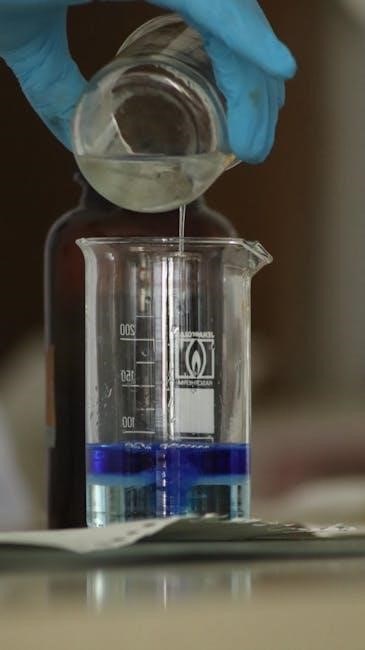
While a direct PDF download of a fully “corrigé” (corrected) version isn’t explicitly mentioned, the textbook itself, along with accompanying workbooks and exercise materials, are key resources․ Interactive activities and a preparation booklet for ministry exams are also available, though some materials may currently be “ÉPUISÉ” (out of stock)․
Optical and Mechanical Phenomena
Resources pertaining to “Trajectoires et phénomènes optiques/Trajectoires et phénomènes mécaniques” (Trajectories and Optical/Mechanical Phenomena) are available as a 3rd edition learning workbook, specifically designed for the 3rd year of Secondary 2․ This material complements the core “Quantum” Chemistry 5 curriculum, though its direct connection to a “corrigé pdf” for the chemistry textbook isn’t explicitly stated․
The workbook focuses on physics concepts, covering trajectories and related phenomena․ While not directly addressing chemistry problem solutions, it represents a supplementary learning tool within the broader “Quantum” series, potentially aiding in understanding related physical principles relevant to chemical processes․
Trajectories and Optical Phenomena
The learning resource “Trajectoires et phénomènes optiques” (Trajectories and Optical Phenomena) is presented as a 3rd edition workbook, geared towards students in the 3rd year of Secondary 2․ This physics-focused material, while part of the broader “Quantum” educational series, doesn’t directly offer a “corrigé pdf” – a solution guide – specifically for Quantum Chemistry 5 problems․
However, understanding trajectories and optical principles can indirectly support comprehension of certain chemical concepts․ The workbook’s interactive activities and exercises aim to solidify understanding of these physical phenomena, potentially providing a foundational base for tackling related challenges within the chemistry curriculum․ It’s currently listed as “ÉPUISÉ” (out of stock)․
Trajectories and Mechanical Phenomena
Similar to “Trajectories and Optical Phenomena,” the workbook covering “Trajectoires et phénomènes mécaniques” (Trajectories and Mechanical Phenomena) is a 3rd edition resource for 3rd-year Secondary 2 physics students within the “Quantum” series․ It’s important to note that a dedicated “corrigé pdf” – a solutions manual – specifically addressing Quantum Chemistry 5 problems isn’t directly available through these physics workbooks․

However, grasping mechanical principles like forces, equilibrium, and friction is crucial for understanding molecular interactions and reaction dynamics․ The workbook’s exercises and interactive elements aim to build a strong foundation in these concepts, indirectly aiding in the study of chemistry; Currently, this resource is also listed as “ÉPUISÉ” (out of stock)․
Topological Quantum Chemistry (Advanced Concept)

While Secondary 5 Quantum Chemistry focuses on foundational principles, the field extends to advanced areas like Topological Quantum Chemistry, explored in Bradlyn et al․’s 2017 Nature publication․ This research delves into the topological properties of electronic band structures in materials, offering a novel framework for understanding chemical bonding and material behavior․
However, resources directly linking this advanced topic to a “corrigé pdf” for standard Secondary 5 Quantum Chemistry exercises are unavailable․ The core curriculum prioritizes fundamental concepts․ Exploring topological quantum chemistry requires a significantly deeper mathematical and physics background beyond the scope of the initial “Quantum” series materials․
Bradlyn et al․ (2017) Research Overview
Bradlyn et al․’s 2017 Nature paper, “Topological quantum chemistry,” introduces a systematic method for classifying the electronic band structures of crystalline materials based on their topological properties․ The research connects symmetry, band topology, and the resulting physical properties, offering a new perspective on material design and understanding․
It’s crucial to note that this advanced research isn’t directly addressed within the standard Secondary 5 “Quantum” chemistry curriculum or associated “corrigé pdf” materials․ While fascinating, it represents a specialized field building upon the foundational concepts taught at this level, requiring advanced mathematical and computational skills․

Applications of Topological Quantum Chemistry
The principles of topological quantum chemistry, stemming from Bradlyn et al․’s (2017) work, have significant implications for materials science, potentially leading to the discovery of novel materials with unique electronic and optical properties․ These include materials exhibiting robust surface states, enhanced thermoelectric efficiency, and potentially even superconductivity․
However, these applications are far beyond the scope of a Secondary 5 quantum chemistry course and its accompanying “corrigé pdf” solutions․ The focus at this level remains on foundational concepts like atomic structure, bonding, and basic chemical reactions, providing a stepping stone for future exploration of advanced topics․